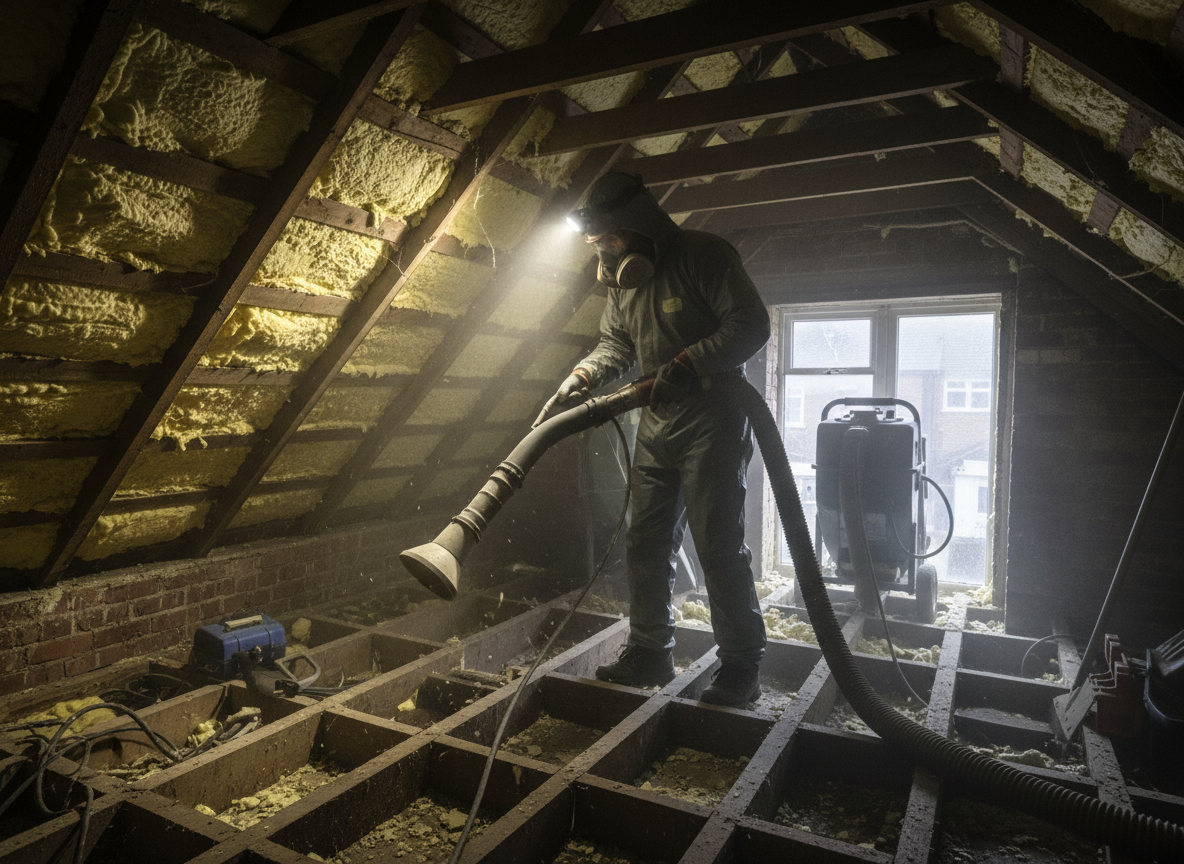
Huddersfield's older housing stock, particularly Victorian and Edwardian stone terraces in areas like Newsome and Almondbury, often contains spray foam applied directly to roof decks or between joists. Closed-cell foam bonds tightly to timber and masonry, trapping moisture that accelerates rot in roofs already exposed to frequent West Yorkshire rainfall. Removal requires careful mechanical scraping and vacuum extraction to avoid damaging original lath and plaster ceilings below, especially where access is limited by narrow loft hatches common in these properties.
Open-cell foam installations in post-war semis around Lindley and Crosland Moor present different challenges, as the material absorbs water and degrades unevenly. Technicians must assess for hidden electrical cables and pipework routed through the foam before starting, using moisture meters to identify saturated sections that could indicate ongoing leaks from the Pennine climate. Disposal follows strict waste regulations for polyurethane materials, with all debris bagged on site and removed the same day to prevent dust settling in living spaces.
Edge cases frequently arise in converted mill buildings near the town centre where foam was used for soundproofing between floors. These jobs demand temporary floor protection and negative air pressure setups to contain particles, as the dense foam often contains embedded debris from previous renovations. Homeowners should expect reinstatement work such as re-boarding and ventilation improvements once the foam is cleared, since original roof spaces in Huddersfield properties were never designed for sealed insulation systems.
Technician insight
In Huddersfield, the thing that catches most people out with Residential Spray Foam Removal is how closed-cell foam in pre-1919 stone terraces traps damp against the roof deck once the original ventilation is blocked, leading to hidden rot that only shows after we start pulling the material away.
Loft Foam Removal in Newsome Terrace
Homeowner in a 1890s stone terrace reported musty smells after heavy rain. Inspection found closed-cell foam bonded to the roof deck with saturated timber beneath. We set up containment, removed the foam mechanically and extracted damp sections, then advised on adding ridge ventilation to prevent recurrence.
How it works
- 1
Initial Inspection
Survey the property to identify foam type, depth, and any hidden services or moisture issues in the roof structure.
- 2
Containment Setup
Install dust barriers, negative air machines and floor protection to keep debris out of living areas during removal.
- 3
Foam Extraction
Use mechanical scraping, chisels and industrial vacuums to remove foam without damaging joists, ceilings or masonry.
- 4
Site Clearance and Disposal
Bag all waste on site, remove it same day and clean the space before checking for any remaining saturated sections.
Pricing
Costs depend on property age, foam depth and access difficulty; contact for a site visit and upfront quote.