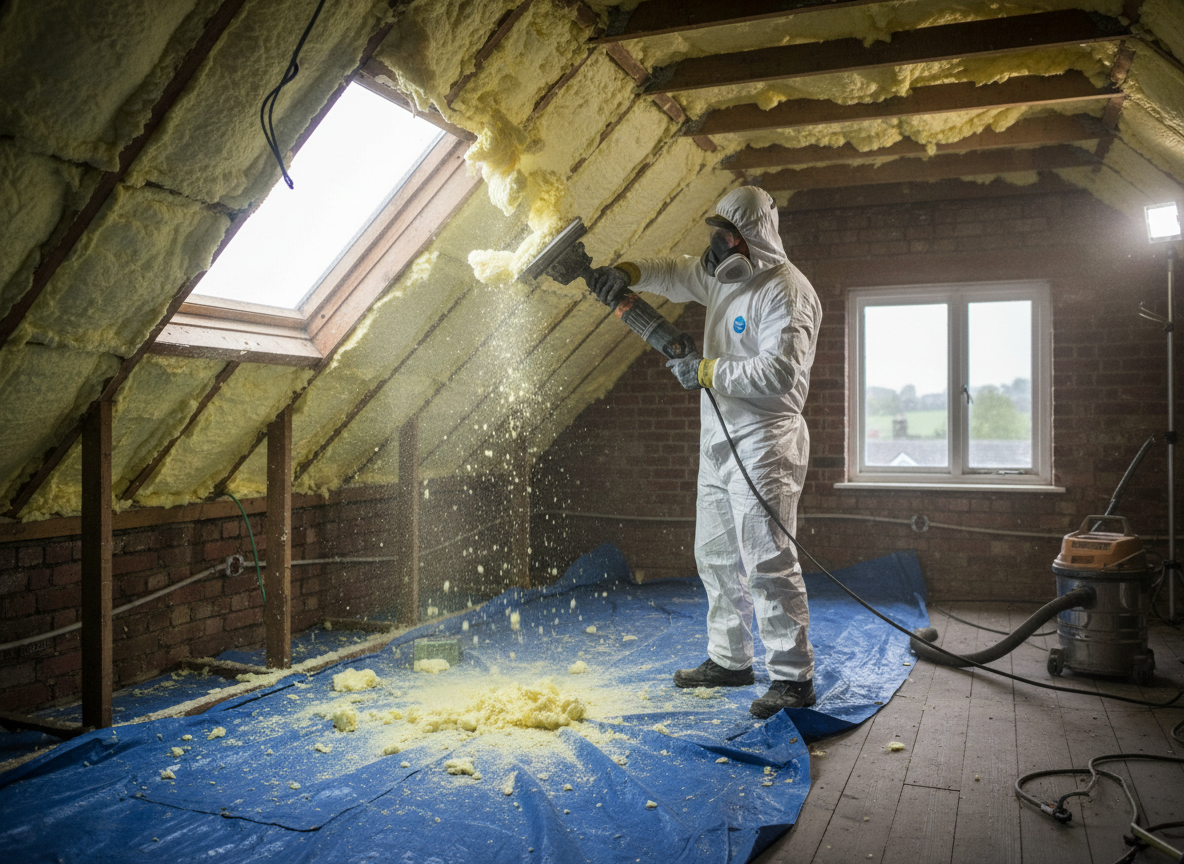
Open cell spray foam bonds tightly to timber joists and masonry in Huddersfield's Victorian terraces and 1930s semis. Removing it requires cutting the foam into manageable sections while protecting original lath and plaster ceilings below. Dust and loose particles fall into wall voids and can travel through chimney breasts common in properties near the town centre, so containment sheeting and negative air machines are essential throughout the job.
West Yorkshire winters bring prolonged damp periods that leave open cell foam saturated. Once moisture is present the material loses insulation value and can promote mould on roof timbers. Extraction crews must check rafter ends and wall plates for rot before any new insulation is considered, especially in properties on the steeper slopes around Lindley and Marsh where rainwater run-off increases loft condensation.
Disposal of open cell foam offcuts must follow local landfill rules for West Yorkshire. The material cannot be left in skips mixed with general waste because of its chemical content. Crews bag and label every load before transport, and any foam that has been in contact with electrical cables or pipework is treated as contaminated and removed separately to avoid future faults.
Homeowners in Huddersfield often discover the foam was applied over existing mineral wool or between ceiling joists without ventilation gaps. This traps warm moist air rising from kitchens and bathrooms, accelerating timber decay. Full removal includes clearing the original insulation, checking for blocked eaves vents, and ensuring the roof space can breathe again before any replacement work begins.
Technician insight
In Huddersfield, the thing that catches most people out with open cell spray foam removal is how the foam has wicked moisture into the original stone walls of 19th-century terraces around the town centre. Once you start cutting, water runs down the inner face and you find the wall plate has started to rot where it meets the external skin.
Loft foam removal in a Marsh terrace
Homeowner noticed mould stains on bedroom ceilings after heavy winter rain. Inspection showed open cell foam applied directly over the original mineral wool in a 1930s terrace. We removed the saturated foam, cleared the blocked eaves, treated the affected joist ends and left the roof space ventilated. No further damp appeared the following season.
How it works
- 1
Site Assessment
Inspect loft or wall cavities, identify foam depth and any hidden services or rot in Huddersfield stone properties.
- 2
Containment Setup
Install dust barriers, negative air filtration and floor protection to stop particles migrating through older terraces.
- 3
Foam Extraction
Cut and remove open cell foam in sections, clearing joists, rafters and wall plates without damaging original timber.
- 4
Void Cleaning and Disposal
Vacuum residual dust, bag all material for compliant West Yorkshire landfill disposal and check for remaining moisture.
- 5
Final Inspection
Verify all foam is gone, photograph cleaned areas and advise on ventilation improvements before handover.
Pricing
Cost depends on access, foam thickness and whether additional rot treatment or ventilation work is needed after extraction.