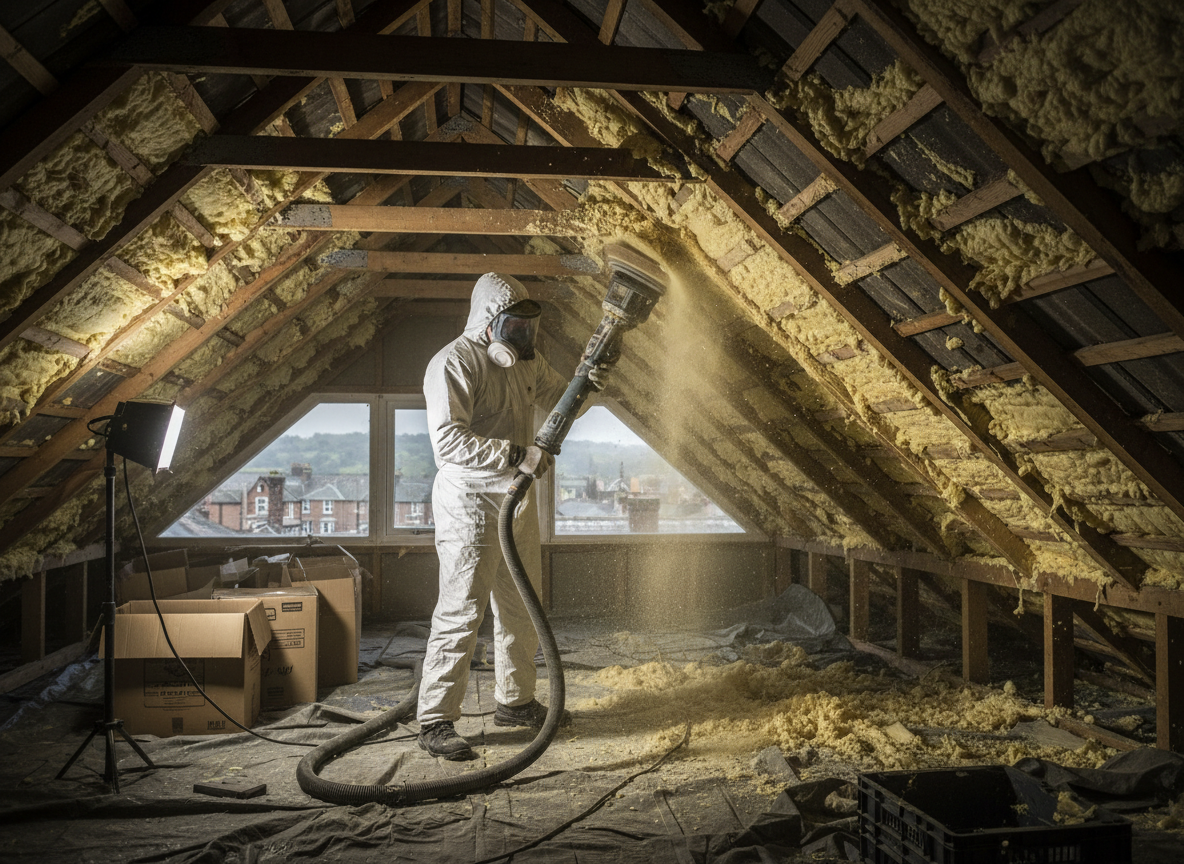
Closed cell spray foam bonds tightly to the stone and brick walls common in Huddersfield's Victorian terraces and Edwardian semis. Removal requires controlled mechanical methods to avoid damaging the irregular masonry that characterises properties near the town centre and along the Colne Valley. Residual foam left behind can trap moisture against the substrate, leading to further issues in the damp Pennine climate.
Edge cases include foam applied over existing lath and plaster ceilings in older homes around Marsh and Lindley, where over-aggressive scraping risks ceiling collapse. Proper containment is essential because closed cell material produces fine dust that settles into floorboards and joist voids typical of the area's two-up two-down stock. Local building practices often mean limited access points, so sections must be removed in sequence rather than in one pass.
Ventilation and dust extraction become critical when working in enclosed roof spaces during Huddersfield's frequent wet winters. The foam's closed cell structure resists simple solvents, so technicians rely on layered removal techniques that protect underlying timbers and electrics common in properties built before 1930. Homeowners in the HD1 and HD2 postcodes frequently discover foam during loft conversions, requiring coordinated extraction before insulation upgrades can proceed.
Technician insight
In Huddersfield, the thing that catches most people out with closed cell spray foam removal is how strongly it grabs onto the rough stone walls in pre-1910 terraces along the Colne Valley. Pennine rain keeps the masonry damp for months, so the foam stays flexible in spots and rock-hard in others, forcing slower, sectional work to prevent pulling render or pointing.
How it works
- 1
Site Assessment
Inspect foam depth, substrate condition and access points in the Huddersfield property to determine removal sequence and containment needs.
- 2
Containment Setup
Seal work zones with sheeting and negative air units to control dust within older stone-built homes around the town centre.
- 3
Mechanical Removal
Use layered scraping and cutting tools to detach closed cell foam without damaging masonry or timber in West Yorkshire terraces.
- 4
Cleanup and Disposal
Vacuum residues, remove debris and clear the space so the property can be inspected for remaining moisture or damage.
Pricing
Cost depends on property age, foam thickness and access difficulty in Huddersfield terraces; upfront quotes provided after inspection.